Mammoth
Permafrost Investigation

In the frozen ground of Siberia and the Yukon, there are animals preserved with a fidelity that defies the conventional timeline. Woolly mammoths, woolly rhinoceroses, wolves, and other megafauna have been found with soft tissue intact, food still in their stomachs, and in some cases, liquid blood still in their veins. The preservation is so extraordinary that some specimens have been described as looking as though they died hours ago, not tens of thousands of years ago.
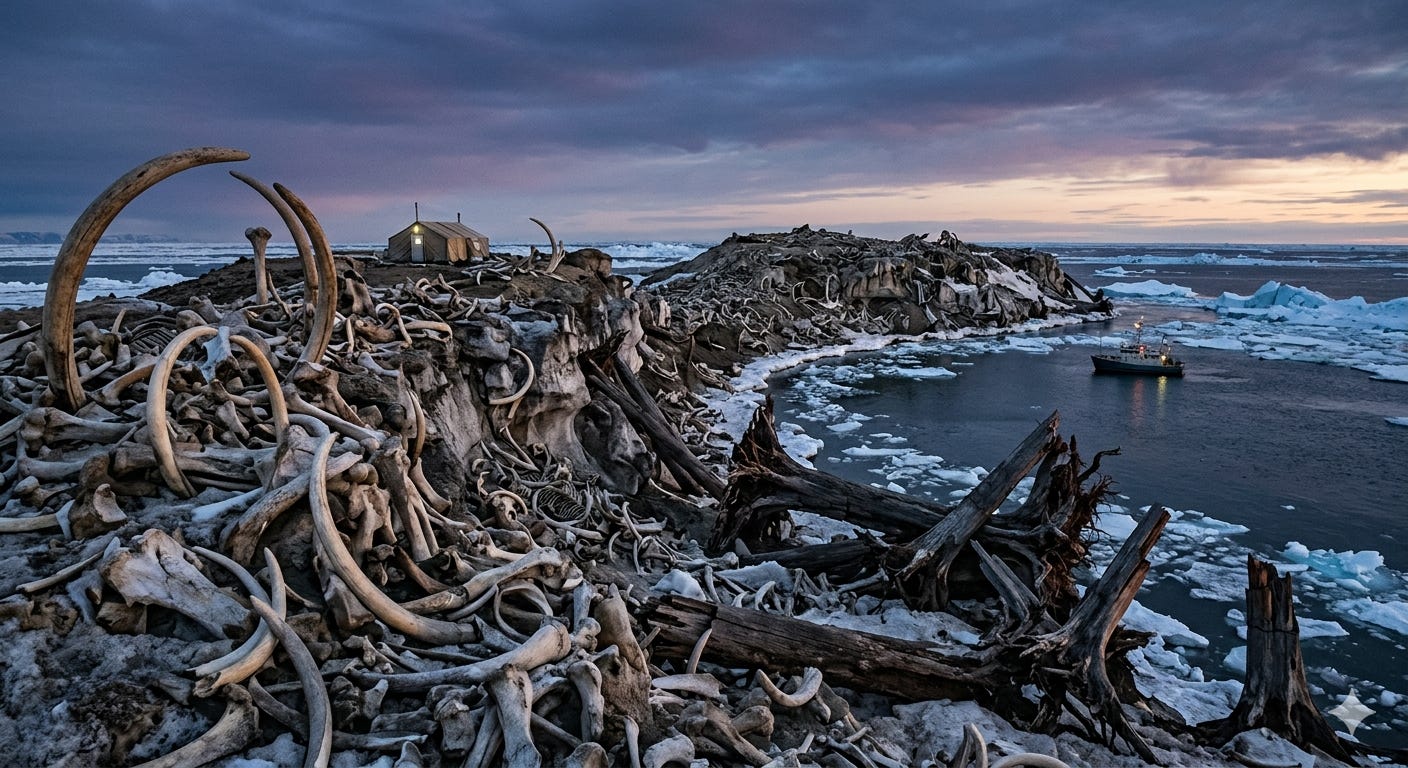
This is not a new discovery. The indigenous peoples of the Arctic have known about these frozen animals for millennia, incorporating them into their mythology and using their tusks for tools and trade. Russian explorers documented “ivory islands” in the 1700s, where the beaches were literally composed of mammoth bones and tusks cemented together by ice. Scientific expeditions in the 19th and 20th centuries recovered specimens that challenged conventional understanding, and in the 21st century, new finds continue to add to the mystery rather than resolve it.
The problem is not the preservation itself, though that is remarkable. The problem is what the preservation implies about the conditions of death and freezing, and how those implications conflict with the established timeline of gradual glacial cycles spanning hundreds of thousands of years. If the ice core chronology from Antarctica represents 420,000 years of gradual accumulation, as mainstream science claims, then how do we explain mammoths frozen so rapidly that their blood never coagulated? How do we explain temperate plants in the stomachs of animals found deep inside the Arctic Circle? How do we explain entire islands composed of megafauna bones, as if herds had been simultaneously killed and deposited by a single event?
Continuing from our recent articles on the analysis of Vostok ice core data in “The 420,000-Year Compression” and the methodology critique in “Ice Core Illusions,” this article examines the mammoth evidence as an independent line of inquiry that converges on the same conclusion: the conventional Pleistocene chronology is fundamentally incorrect, and the evidence points to catastrophic compression rather than gradual accumulation.
The Evidence: Mammoths
The Classic Cases
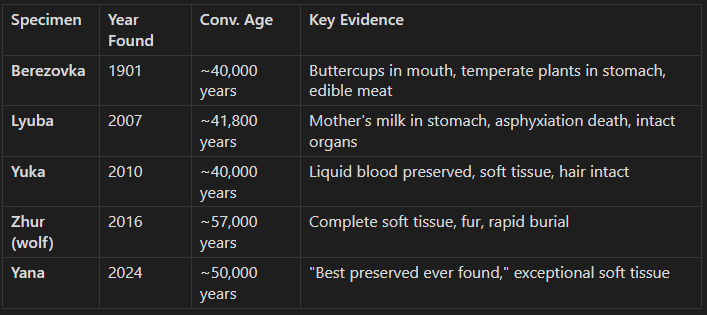
The Berezovka mammoth, discovered in 1901 on the banks of the Berezovka River in northeastern Siberia, remains one of the most thoroughly documented cases of extraordinary preservation. The animal was found in a standing position, half-buried in permafrost, with its front legs broken as if from a fall. When scientists excavated the carcass, they found that the muscle tissue was still red and edible when thawed. More remarkably, the mammoth’s mouth contained buttercups and other temperate plants—species that do not grow in the Arctic tundra where the animal was found.
The stomach contents revealed an even greater anomaly: undigested plant matter from species that currently grow only in southern Siberia, hundreds of kilometers to the south. This was not a single anomaly. Multiple mammoth specimens have been found with similar stomach contents, indicating that these animals were feeding on temperate vegetation immediately before death, yet they died and were preserved in the Arctic. Either the Arctic was once temperate and became frozen almost instantly, or the animals were transported from temperate zones to the Arctic in a single catastrophic event.
“The contents of the stomachs have been carefully examined; they showed the undigested food, leaves of trees now found in Southern Siberia, but a long way from the existing deposits of ivory. Microscopic examination of the skin showed red blood corpuscles, which was a proof not only of a sudden death, but that the death was due to suffocation either by gases or water.”
— D. Gath Whitley, “The Ivory Islands in the Arctic Ocean” (1910)
The preservation of red blood corpuscles—red blood cells—requires explanation. These cells begin to degrade within hours of death under normal conditions. For them to be preserved visibly under microscopic examination, the freezing must have occurred faster than cellular decomposition—within hours at most—and then been maintained continuously at temperatures low enough to prevent thaw-related degradation for millennia. This is not gradual freezing; this is flash-freeze preservation.
The Ivory Islands
Perhaps the most dramatic evidence comes not from individual specimens but from entire landscapes composed of megafauna remains. The Liakhov Islands and the New Siberian Islands, located north of the Siberian mainland deep inside the Arctic Circle, were documented by early explorers as being literally built on mammoth bones.
“Such was the enormous quantity of mammoths’ remains that it seemed... that the island was actually composed of the bones and tusks of elephants, cemented together by icy sand.”
— Nordenskjold Expedition (1878)
Another observer noted: “The soil of these desolate islands is absolutely packed full of the bones of elephants and rhinoceroses in astonishing numbers.” Mammoth tusks have been dredged from the Arctic Ocean floor between islands, indicating that the seafloor was once dry land supporting megafauna populations. After Arctic storms, beaches are strewn with fresh tusks cast up by waves—so many that for centuries, the ivory trade depended on “beach ivory” rather than hunting.
This is not the signature of gradual extinction over tens of thousands of years. This is the signature of mass death—entire herds, possibly entire populations, killed and deposited simultaneously. The concentration of remains suggests a catastrophe of continental scale, not the slow attrition of a changing climate.
Modern Discoveries: The Pattern Continues
In December 2024, Russian scientists unveiled what they called the “world’s best-preserved mammoth carcass.” Named Yana after the river basin where she was discovered in the Batagaika crater, this juvenile mammoth was described as “exceptional” and “remarkably well-preserved”—better even than previous record-holders like Yuka and Lyuba. She is one of only seven whole mammoth carcasses ever found, and her preservation continues the pattern established by earlier discoveries.
Yuka, discovered in 2010, achieved scientific fame for containing liquid blood. When researchers cut into the carcass, blood flowed from the wounds. The blood was dark and thick—”the consistency of jelly” according to one researcher—but it was still liquid. Blood does not remain liquid at permafrost temperatures. It freezes solid at around -2 degrees Celsius. For blood to remain in a preserved but unfrozen state for tens of thousands of years requires either continuous deep-freeze conditions below -60 degrees Celsius (which would have destroyed the tissue in other ways) or a preservation mechanism that mainstream science has not explained.
Lyuba, discovered in 2007, was a baby mammoth only 30-35 days old at death. She was so well preserved that her mother’s milk remained in her stomach, along with fecal matter in her intestine (normal for nursing elephant calves). Analysis of sediment in her trunk and throat indicated asphyxiation—death by drowning or suffocation. The preservation mechanism proposed by scientists involves lactic acid produced by bacteria, but this requires specific conditions and rapid burial that do not fit the gradual accumulation model.
Zhur, a wolf pup discovered in the Yukon in 2016, was dated to approximately 57,000 years ago but preserved with complete soft tissue and fur. “She is complete, with all her soft tissues intact and even her fur,” said Julie Meachen of Des Moines University. “This is a very rare find.” But the question remains: why is it rare? If the permafrost has existed for tens of thousands of years, and animals have been dying throughout that period, where are all the other mummies? The rarity of preserved specimens suggests exceptional conditions, not normal processes.
The Associated Evidence: Trees, Bones, and the Frozen Landscape
Petrified Forests on Arctic Islands
The mammoths were not alone. On the New Siberian Islands, the same expeditions that documented ivory beaches also discovered petrified forests—tree trunks standing upright and lying horizontally in the frozen soil, preserved in positions that indicated violent transport and rapid burial. Hedenstrom and Sannikov, explorers in 1806, reported that “the trunks of the trees in these ruins of ancient forests were partly standing upright and partly lying horizontally buried in the frozen soil. Their extent was very great.”
Eduard von Toll, who explored the islands between 1885 and 1902, provided an even more detailed account: “On the summit of the hills they [the trunks of trees] lie flung upon one another in the wildest disorder, forced upright in spite of gravitation, and with their tops broken off or crushed, as if they had been thrown with great violence from the south on a bank, and there heaped up.”
The implications are clear. These were not forests that grew in place and gradually died. These were trees uprooted by catastrophic force, transported northward, and deposited on Arctic islands along with the megafauna. The presence of charcoal and what von Toll called a “bituminous agent” suggests exposure to intense heat—perhaps the same electrical discharge or plasma conditions that Velikovsky proposed as the mechanism for the catastrophe. The trees and the mammoths share the same fate: sudden death, violent transport, rapid burial, and instant freezing.
Other Megafauna: A Pattern of Instant Preservation
Mammoths are the most famous, but they are not unique. The permafrost preserves woolly rhinoceroses, cave bears, horses, bison, and wolves—all with the same extraordinary preservation that indicates instant death and immediate freezing. A woolly rhinoceros discovered in Siberia in 2020 was so well preserved that its fur and internal organs were intact. A cave bear found in 2020, dated to approximately 39,000 years ago, had its nose, teeth, and internal organs preserved.
The consistency across species indicates that this was not a matter of individual animals dying in favorable conditions for preservation. This was a population-level event—or series of events—that affected multiple species simultaneously across a vast geographic area. The animals did not gradually accumulate in the permafrost over tens of thousands of years; they were deposited in catastrophic pulses that left the same preservation signature across all specimens.
The Mechanism: The Evidence for Instantaneous Catastrophe
The conditions under which these animals are found demand a mechanism of death and preservation that mainstream science struggles to explain within a gradualist framework.
Flash-Freeze Preservation: For red blood cells to remain visible and meat to stay edible for millennia, freezing must have occurred within hours of death to prevent cellular decomposition. This requires a sudden, extreme drop in temperature—described by geologist J.D. Dana as occurring over “a single winter’s night”.
Stomach Contents and Tropical Anomalies: Specimens like the Berezovka mammoth were found with undigested buttercups and temperate plants in their mouths and stomachs. These species do not grow in the Arctic tundra, suggesting the animals were either feeding in a temperate climate that froze instantly or were violently transported from southern zones.
Liquid Blood: The 2010 discovery of the mammoth Yuka revealed liquid blood that flowed from wounds when the carcass was cut. Since blood freezes at approximately -2°C, its preserved liquid state suggests a preservation mechanism outside of normal permafrost behavior.
Suffocation Evidence: Multiple specimens, including Lyuba and the Berezovka mammoth, show signs of asphyxiation by water, debris, or gases rather than freezing to death. This indicates a catastrophic sequence: a lethal flood or atmospheric event followed immediately by thermal collapse. This is significant because it separates the mechanism of death from the mechanism of preservation.
The Velikovsky Mechanism Revisited
Immanuel Velikovsky, in “Earth in Upheaval” (1955), proposed a mechanism that accounts for all the evidence: electromagnetic interaction between Earth and a charged cosmic body, causing axis shifts, thermal collapse, and rapid deposition of atmospheric water as snow and ice. The mechanism explains the simultaneous occurrence of flooding (suffocation evidence), temperature collapse (flash-freeze evidence), and transport of debris (uprooted forests, bone beds).
Under this model, ocean water would be atmosphericized by electrical discharge—evaporated and carried into the atmosphere as vapor. The thermal collapse from dust and debris in the atmosphere would cause rapid condensation, depositing massive quantities of snow and ice at the poles. Animals caught in the flood waters would be drowned, then instantly frozen as the thermal collapse took effect. The entire sequence—from living animal to frozen mummy—could occur within hours.
This is not the only possible mechanism, but it is one that accounts for the full range of evidence. Mainstream science has no comparable explanation. The conventional model proposes gradual climate change over thousands of years, but cannot explain how animals were flash-frozen with food in their mouths. It proposes slow migration and adaptation, but cannot explain why mass death sites exist. It proposes long-term permafrost stability, but cannot explain why preservation is so rare if that stability has existed for millennia.
The Dating Problem: Why the Ages May Be Wrong
The Radiocarbon Inflation
The 40,000 to 57,000-year ages assigned to mammoths are not direct measurements of time, but interpretations of Carbon-14 ratios. This dating method relies on a calibration curve that is only physically verified by tree rings back to about 14,000 years. Beyond that, it assumes a constant rate of C-14 production in the atmosphere—an assumption that fails during magnetic catastrophes.
Specifically, events like the Laschamp geomagnetic excursion (~41,000 BP) collapse Earth’s magnetic shield, triggering a massive spike in cosmic rays and C-14 production. Any organism living during such a pulse would absorb “excess” carbon, making them appear thousands of years older than they actually are. If the Pleistocene cataclysms included multiple magnetic shifts, the entire mammoth timeline is not a record of vast ages, but a systematically inflated “ghost” of a much shorter, more violent window.
The Vostok Connection
The analysis of the Vostok ice core in “The 420,000-Year Compression” revealed that the ice assumed to represent over 400,000 years of gradual accumulation shows no evidence of separate formation events. The electrical conductivity signal that should record volcanic activity over that period is entirely absent in the deep ice. The dust neutralization hypothesis proposed to explain this absence was falsified by the actual dust concentration data.
If the Antarctic ice formed rapidly during catastrophe pulses rather than gradually over hundreds of thousands of years, then the same may be true of the northern permafrost. The mammoths frozen in Siberia and the Yukon may not be tens of thousands of years old in real time; they may have been deposited during the same catastrophe sequence, their “ages” inflated by the same methodological assumptions that compress the Vostok record.
This would explain the pattern of evidence: the instant preservation, the mass death sites, the temperate plants in Arctic animals, the simultaneous disappearance of megafauna across multiple continents. It would explain why all the preserved specimens cluster in the same general radiocarbon “age” range—they represent a single compressed event, not a distribution across tens of thousands of years.
The Witnesses: What the Evidence Tells Us
Darwin’s Admission
Charles Darwin, who built his theory on gradual change over long periods, found the mammoth evidence inexplicable. In correspondence with Sir Henry Howorth, he wrote that the extinction of mammoths in Siberia was for him “an insoluble problem.” This admission from the founder of gradualist evolutionary theory is significant. If the evidence fit the gradualist framework, Darwin would have embraced it. That he could not explains why mainstream science has struggled with this evidence ever since.
Georges Cuvier, the great French paleontologist of the early 19th century, had no such difficulty. Working before Darwin’s framework became dominant, Cuvier interpreted the evidence as it appeared: “In a vast catastrophe of continental dimensions the sea overwhelmed the land, the herds of mammoths perished, and in a second spasmodic movement the sea rushed away, leaving the carcasses behind. This catastrophe must have been accompanied by a precipitous drop in temperature; the frost seized the dead bodies and saved them from decomposition.”
Cuvier got it right in 1825. Two centuries of gradualist assumption have not produced a better explanation—only more elaborate rationalizations for why the evidence doesn’t mean what it appears to mean.
The Generational Gap
If the Pleistocene represents tens of thousands of years of human coexistence with megafauna, where is the evidence of that coexistence? The archaeological record shows isolated episodes of occupation at scattered sites, not the continuous presence that would accompany such durations. Gibraltar’s caves are said to have been occupied for 76,000 years—3,040 generations—yet show no accumulation of burials, no technological evolution, no population growth signal. The pattern is refuge, not residence.
The same pattern appears in the permafrost. If mammoths and other megafauna lived in the Arctic for tens of thousands of years, where are the gradual accumulations of bones from natural mortality?
Conclusion: The Mammoth Question Answered
This convergence of evidence suggests that the Pleistocene was not a gradual era of hundreds of thousands of years, but a high-energy catastrophe sequence that ended a world of megafauna in a matter of hours or days.
Sources
Velikovsky, I. (1955). Earth in Upheaval, “The Ivory Islands”.
Whitley, D. Gath (1910). “The Ivory Islands in the Arctic Ocean.” Journal of the Philosophical Society of Great Britain, XII.
Dana, J.D. (1894). Manual of Geology (4th ed.).
Cuvier, G. (1825). Discours sur les revolutions de la surface du globe.
BBC News (December 23, 2024). “Scientists unveil 50,000-year-old baby mammoth remains.”
National Geographic. “Ice Baby” — Lyuba analysis.
CBS News. “Woolly mammoth containing liquid blood discovered in Russia.”
Business Insider (September 11, 2024). “Yukon gold miners are unearthing mummified ancient creatures.”
NOAA Paleoclimatology Program. Vostok 2011 ECM data; Vostok dust concentration data.
The end of the last world was pretty dramatic, it seems.