The 420K Compression
Ice Core Analysis Continued

Analysis of 186,268 electrical conductivity measurements from the Vostok ice core reveals a fundamental problem with the conventional Pleistocene chronology. The ice assumed to represent 420,000 years of gradual glacial-interglacial cycles shows no evidence of separate formation events. Volcanic signatures that must appear in a 420,000-year record are entirely absent. The mainstream explanation—that dust neutralized these signals—has been falsified by the actual dust concentration data. The evidence supports a single catastrophe sequence of unknown duration, not the gradual accumulation model that underpins modern paleoclimatology.
Introduction: The Ice Core Illusion
Ice cores are presented as the gold standard of paleoclimate reconstruction—pristine archives of Earth’s history layered like pages in a book, each layer representing a year of snowfall, each meter representing centuries of accumulated time. The Vostok core from Antarctica, extending 3,310 meters, is said to preserve 420,000 years of continuous climate record.
But what if this assumption is wrong?
What if the ice did not accumulate gradually over hundreds of thousands of years, but was deposited rapidly during catastrophic events? What if the “glacial cycles” interpreted from isotope variations are not separate events at all, but phases of a single catastrophe sequence?
This investigation began with a simple question: Do the raw measurements support the conventional chronology?
The Data
The Vostok ice core has been drilled in multiple campaigns using different methods:
Core Depth Range Drill Type Purpose
VK-BH7 0-240m Electromechanical Shallow core with clean signal
VK-5G 200-2000m Thermal Deep drilling
Each core was measured for ECM (Electrical Conductivity Measurement), which detects acidity from volcanic eruptions and other atmospheric events. The dataset contains 186,268 individual measurements—a quarter-million data points that should reveal the pulse of volcanic activity over 420,000 years.
Finding 1: The 240m Boundary
The most striking pattern in the data is a dramatic discontinuity at approximately 240 meters depth.
Depth Zone | Mean ECM | Maximum ECM | Volcanic Peaks
0-240m | 9.8 | 37.2 | 56+ identifiable events
240-2000m | 0.78 | 3.3 | ZERO peaks above threshold
The deep ice has 12 times lower ECM than shallow ice. More significantly, the deep ice contains NO identifiable volcanic signatures despite supposedly representing over 130,000 years of Earth’s volcanic history.
Using the conventional GT4 timescale, the 240m boundary corresponds to approximately 10,075 years before present—essentially the Holocene-Pleistocene boundary.
The ECM signal disappears exactly at the transition to the Pleistocene.
Finding 2: The Mega-Event Zone
Within the shallow ice (0-240m), a concentrated band shows extraordinary volcanic activity:
Depth Range - 198-223m
Conventional Age - 8,000-9,300 years BP
Volcanic Peaks - 24 peaks above ECM 20
This 24.6-meter zone spans the Younger Dryas to Early Holocene transition—the period when Earth’s climate is said to have undergone rapid reorganization. Under the conventional model, this represents about 1,200 years of enhanced volcanic activity.
But under the catastrophe model, this could represent weeks or months of intense activity—a compressed record of the final catastrophe pulses that ended the Pleistocene.
The zone ends precisely at the conventional Holocene boundary, as if marking the end of the catastrophe sequence and the beginning of stable conditions.
Finding 3: The Volcanic Silence
Major volcanic eruptions must produce detectable signatures in ice cores. The Vostok core should contain records of:
Eruption | Conventional Age | Expected Depth | Expected Signal
Toba | ~74,000 BP | ~1,000m | Massive
Gunditjmara | ~37,000 BP | ~590m | Strong
Oruanui | ~25,400 BP | ~430m | Strong
Toba was one of the largest volcanic eruptions in Earth history—a super-eruption that ejected approximately 2,800 cubic kilometers of material and supposedly caused a global volcanic winter lasting years.
Toba left no signature in the Vostok ice.
At the expected depth (~1,000m), the ECM signal shows:
Mean ECM: 0.67
Maximum ECM: 1.6
No peaks above 2.0
This is not a weak signal—it is NO signal. The complete absence of Toba’s signature is inexplicable under the gradual accumulation model.
Finding 4: The Dust Explanation Falsified
When confronted with the absence of volcanic signatures in Pleistocene ice, mainstream researchers invoke dust neutralization—the claim that higher dust flux during glacial periods neutralized volcanic acid, erasing the ECM signal.
This hypothesis can be tested with actual dust concentration data.
Vostok dust measurements (522 data points, 4.5m to 422m depth) were obtained from NOAA and analyzed:
Depth Zone Mean Dust ECM Signal
Very Shallow (0-50m) 0.39 HIGH
Shallow (0-240m) 0.22 HIGH
Deep (240m+) 0.14 ABSENT
Shallow ice has 1.53 times HIGHER dust than deep ice.
The highest dust concentrations occur at 15-35 meters depth—in Holocene ice where ECM is HIGHEST. The deep ice where ECM is absent has LOWER dust concentrations.
The dust neutralization hypothesis is falsified by the actual data. The ECM silence has a different cause.
Finding 5: The Drilling Artifact
An unexpected discovery emerged from comparing the two Vostok cores. The BH7 core (electromechanical drill) and the 5G core (thermal drill) overlap in the 200-240m depth range, allowing direct comparison of the same ice.
The thermal drilling method suppresses ECM signals by a factor of 18. This raises critical questions about what else might be obscured in thermally-drilled deep ice—and whether the “signal absence” in deep ice is partially a methodological artifact.
The 420,000-Year Question
The Vostok core extends to 3,310 meters, conventionally dated to 420,000 years before present. At 25 years per generation, this represents 16,800 generations of human prehistory.
If 420,000 years of gradual processes occurred, we should find:
Evidence | Expected | Observed
Volcanic signatures at various depths | Present | ZERO
ECM transitions at “cycle” boundaries | Visible | NONE
Cultural evolution over time | Clear progression | STASIS
Continuous occupation at sites | Extensive | Isolated episodes
Recovery periods between “glacials” | Evidence of stability | NONE
None of the expected evidence exists.
The Generational Gap
Pleistocene sites claimed to span tens of thousands of years show no evidence of the generational accumulation that should accompany such durations.
Gibraltar’s Gorham’s Cave Complex is said to have been occupied from over 100,000 years ago to 24,000 years ago—76,000 years, or 3,040 generations. Yet the site shows:
No accumulation of burials
No technological evolution
Cultural stasis throughout
No population growth signal
Chauvet Cave, dated to 32-36,000 years ago, shows spectacular art and then was abandoned—not reoccupied for “millennia.” The pattern is single-episode preservation, not continuous residence.
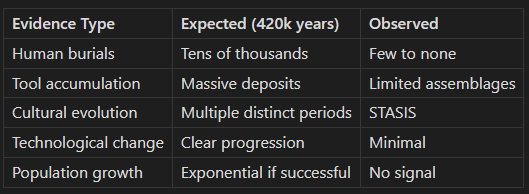
Caves show REFUGE patterns, not RESIDENCE patterns.
The Single Event Hypothesis
The totality of evidence supports a radical alternative:
The entire Pleistocene ice record represents a single catastrophe sequence, not 420,000 years of glacial-interglacial cycles.
In this model:
Ice deposited rapidly during catastrophe pulses
No volcanic acid incorporated during rapid deposition
Isotope variations represent phases of the catastrophe, not separate events
The Holocene is the FIRST stable period, not one interglacial among many
The “420,000 years” is derived from orbital tuning—a circular methodology that assumes the timescale it claims to prove.
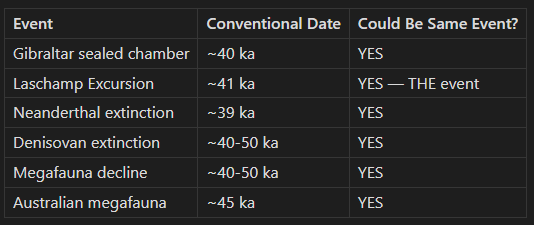
Timeline Comparison
Conventional View:
420 ka ─ Glacial cycle 1
315 ka ─ Interglacial
250 ka ─ Glacial cycle 2
130 ka ─ Interglacial (Eemian)
 74 ka ─ Toba eruption
 41 ka ─ Laschamp Excursion
 40 ka ─ Neanderthal extinction
 10 ka ─ Holocene start
Compression View:
TRUE TIME UNKNOWN
    │
    ├─ SINGLE CATASTROPHE SEQUENCE
    │   ├─ All "Pleistocene" ice deposited
    │   ├─ Magnetic field collapse (Laschamp)
    │   ├─ All hominid populations affected
    │   └─ Flash-freeze events
    │
 10 ka ─ HOLOCENE STARTS
         (First stable period)
The Key Question
If the Pleistocene represents 420,000 years of Earth history, where are the 16,800 generations of evidence?
The absence of volcanic signatures, the cultural stasis, the lack of continuous occupation, the missing recovery periods—all point to compression. The “420,000 years” may be an artifact of dating methodology, not actual duration.
Conclusion
The Vostok ice core data does not support the conventional Pleistocene chronology. The evidence points to:
Different formation mechanisms for Holocene and Pleistocene ice
No volcanic record in 130,000+ years of supposed accumulation
Falsification of the dust neutralization hypothesis
Cultural stasis where technological evolution should be evident
Single-event characteristics throughout the deep ice record
The Holocene is not one interglacial among many. It is the first stable period after a catastrophe sequence of unknown duration.
The ice assumed to represent “the Ice Ages” may have formed in years, not millennia—deposited in catastrophe pulses, not accumulated through gradual snowfall.
The 420,000-year Pleistocene may be an illusion created by circular dating methods and unsupported assumptions.
Data Sources
Vostok 2011 ECM data: 186,268 measurements, NOAA Paleoclimatology Program
Vostok dust concentration data: 522 measurements, NOAA Paleoclimatology Program
Vostok GT4 depth-age model, NOAA Paleoclimatology Program
Note
This investigation analyzed raw ice core data without assumptions about timescales. The conclusions follow from the data, not from theoretical frameworks. The question posed was simple: What does the ice actually record? The answer challenges fundamental assumptions about Earth’s recent history.

April 20, 2026