Galileo’s Mistake. Exposing Science’s Unspoken Crisis of Nuance
(And Why You’ve Never Heard Scientists Admit He Was Wrong)

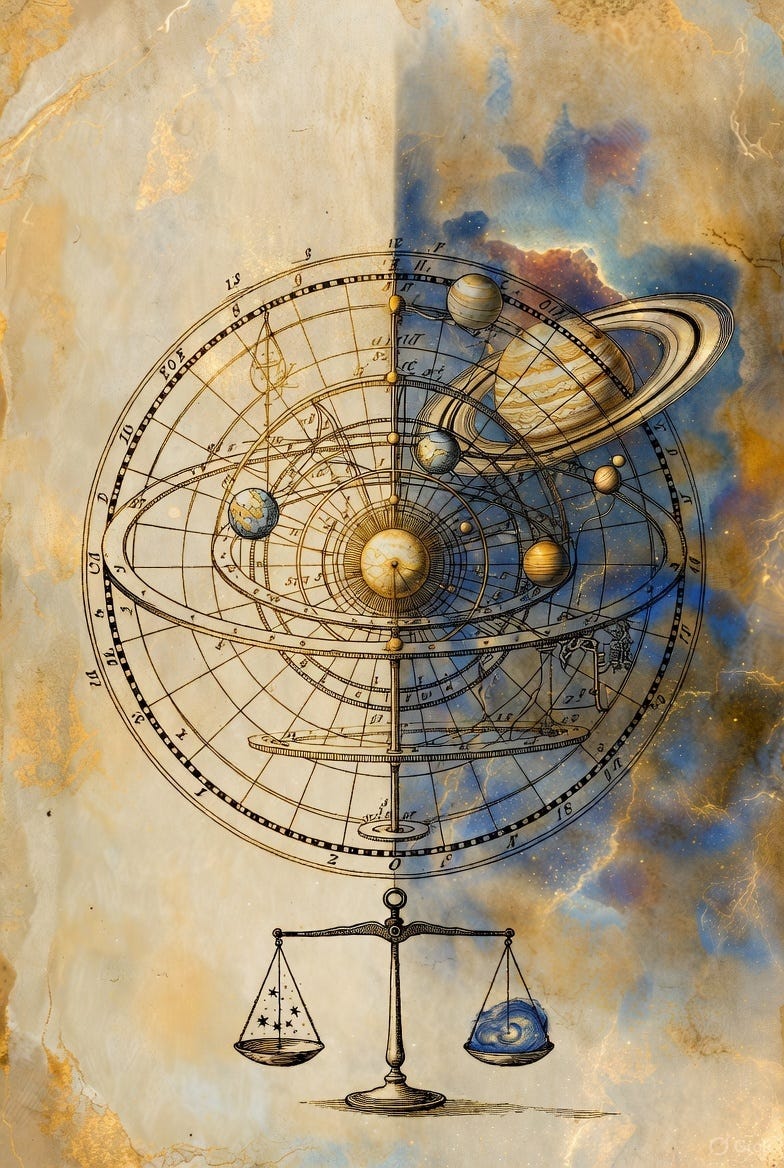
We’ve all heard the story: Galileo, the bold truth-teller, persecuted by a dogmatic Church for daring to say the Earth moves. It’s the foundational myth of science’s triumph over ignorance. But what if this narrative itself is a dogma—one that hides a deeper crisis in how we understand scientific truth today?
Digging through archives and overlooked histories, I found a startling pattern: Scientists themselves repeatedly criticized Galileo—not for his model’s accuracy, but for his rhetoric. Yet this nuance vanishes from Google searches, AI summaries, and pop-science lore. Why? Because it forces us to confront an uncomfortable truth: Science struggles to articulate the gap between models and reality—and we’ve stopped training scientists to even try.
I. The “Apology” You Won’t Find on Google: Scientists vs. Galileo
In 1929, physicist-turned-philosopher Philip Frank stood before the Vienna Circle in Prague and delivered a bombshell: Galileo overstepped. His lecture, later published in Modern Science and Its Philosophy (1949), argued that Galileo’s fatal error wasn’t proposing heliocentrism—it was claiming it was absolute “truth,” not a predictive model. For Frank, this blurred science into metaphysics, provoking unnecessary conflict .
Frank wasn’t alone. Decades later, Pope Benedict XVI invoked philosopher Paul Feyerabend (an “epistemological anarchist” born in Vienna) who provocatively stated:
“The church at the time of Galileo was much more faithful to reason than Galileo himself. Its verdict against Galileo was rational and just.”
Feyerabend’s point wasn’t pro-Church—it was anti-dogma. He argued Galileo’s certainty violated scientific restraint when key empirical evidence (like stellar parallax) was still missing. Tycho Brahe’s geocentric model, in fact, matched existing data better .
II. The Crisis Google Hides: Why Scientists Avoid the Model-Reality Gap
Modern searches drown these critiques in oversimplified “science vs. faith” narratives. But the deeper issue is epistemological: Science education rarely teaches the distinction between:
Model Accuracy: Does a theory predict observations? (Heliocentrism did)
Model Ontology: Does it describe reality “as it is”? (Galileo claimed it did)
As the UCLA historical analysis confirms, Galileo’s real offense was insisting heliocentrism was physically true after being warned in 1616 to treat it hypothetically. His 1632 Dialogue mocked geocentrists as “simpletons,” framing his model as transcendent truth .
But scientists then knew better:
Jesuit astronomers verified Galileo’s observations (moons of Jupiter, phases of Venus) but rejected his interpretation because stellar parallax remained undetected .
Tycho Brahe argued cogently that without observable parallax, stars would need to be absurdly large—a real scientific objection .
III. The Dogma in Modern Science: “Shut Up and Calculate”
Today, we repeat Galileo’s error. We treat scientific models (quantum fields, curved spacetime) as literal truth—not tools. This manifests as:
Education Failure: STEM curricula prioritize equations over philosophy. Few physicists study logic or Popper (falsifiability), leaving them unequipped to articulate model limitations .
Rhetorical Excess: Neil deGrasse Tyson declares “The good thing about science is that it’s true” — mirroring Galileo’s ontological overreach.
Public Miscommunication: When models shift, science “loses credibility” because we marketed hypotheses as certainties.
The result? A replication crisis, mistrust, and a culture that can’t distinguish between “useful” and “true” .
IV. The Way Forward: Teaching Science as Map-Making
The solution lies in resurrecting a nuanced framework:
Embrace Korzybski’s Razor: “The map is not the territory.” Geocentrism remains useful for navigation; quantum mechanics for micro-engineering. Neither is “reality” .
Require Philosophy of Science: As Philip Frank urged, teach models as tools for prediction, not metaphysical claims.
Reward Intellectual Humility: Celebrate scientists like Bohr who said, “It is wrong to think the task of physics is to find out how Nature is. Physics concerns what we can say about Nature.”
Geocentrism is best for Navigation, celestial navigation , but fails at planetary mechanics, cosmology
Heliocentrism is best for Orbital mechanics, gravity modeling, but fails in relativistic/general cosmic contexts
V. Conclusion: Science After the Dogma
Galileo was empirically right about heliocentrism’s predictive power. But his insistence on its metaphysical truth was unscientific. Today, culture conflates models with reality, then panics when they evolve.
The missing nuance isn’t buried because of a Church conspiracy—it’s buried because it forces us to admit science is human, fallible, and gloriously provisional. As Feyerabend warned: “The only absolute truth is that there are no absolute truths.”
Reclaiming that humility isn’t a retreat from science—it’s its redemption.
P.S. If this resonates, share it with a scientist or educator. We need to stop training technicians and start nurturing natural philosophers.
Sources: Church History Journal (UCLA) ; Catholic.com ; America Magazine ; Philip Frank’s “Modern Science and Its Philosophy” ; Feyerabend archives.